


Hazardous chemicals must be stored in a locked room or in locked cupboards. For some substances, the school is required to maintain a system for logging their use.
Particular attention should be given to substances that may serve as precursor materials for explosives or illicit drugs. These should be checked regularly.
Read more: Legislation Restricting the Use of Chemicals
Before deciding where a substance is to be stored, a risk assessment must be carried out that considers the properties, hazard classes, and quantities, as well as any reactions that may occur in the event of leaks or spills of the substance. The result of the assessment must be documented, for example in the school’s chemical list or inventory, so that it is clear which substances have been assessed, and which measures have been implemented to reduce the risk to an acceptable level. To make it easier to stay organised and to find what is needed, all chemicals should have a designated storage location.
It can be tempting to organise substances alphabetically, but their placement must primarily consider the substance’s hazard class(es) and any other storage requirements. Within groups of substances that can be stored together, alphabetical organisation may well be used, but in some cases, it is easier to locate substances by organising them by substance group, for example by grouping alcohols or metals together. This is particularly useful for larger chemistry departments.
Chemical storage cupboards may be made of metal or wood, and the choice of cupboard type must be adapted to the hazardous properties of the substances to be stored.
- Flammable substances must be stored in fire-resistant cupboards.
- Oxidising substances must be stored in cupboards made of metal or other non-combustible material.
- Corrosive chemicals must be stored in corrosion-resistant cupboards. Liquid, corrosive chemicals should additionally be placed in a secondary container, for example a plastic tray.
- Volatile substances must be stored in a ventilated cupboard so that contaminated air is led out of the room and building.
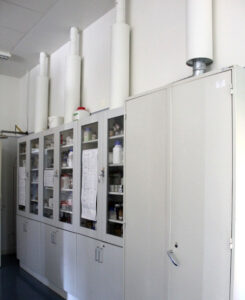
For cupboards with ventilation, the ventilation should be connected so that contaminated air is not distributed to other cupboards or parts of the building but is exhausted to the outside. The ventilation in the cupboards should be checked regularly, for example every five years. It is also important to check that the cupboard hinges are not damaged or rusty, for example due to contact with acids.
Some chemicals must be stored in a specific way to ensure stability and shelf life:
- Substances that must be stored cold should be placed in a refrigerator or freezer. These must be labelled in the same way as other chemical cupboards.
- Light-sensitive chemicals should be stored in the dark. If this is not possible, the container must be dark or wrapped in aluminium foil or another lightproof material.
- Peroxides and peroxide-forming chemicals should be stored in the dark and at the correct temperature in accordance with the information in the safety data sheet.
- Fats and oils are preferably stored in the dark.
Cupboards for storing gas burners and gas cylinders must be fire-resistant and placed in well-ventilated rooms above ground level. All gas cylinders must be stored in an upright position, and the quantity of gas should be limited to what is necessary for teaching.
Chemical storage cupboards should not be placed in or near evacuation routes. Cupboards used for gas storage must be in rooms above ground level and with good ventilation. Large containers and liquid chemicals should be stored below eye level; this is particularly important for concentrated acids and bases.
Areas and locations where hazardous substances are stored, such as flammable substances, reactive materials, or gases under pressure, should be marked with appropriate symbols indicating the specific type of risk.
Some chemicals can react with each other and generate intense heat, fire, or explosions. Information on the storage of incompatible chemicals can be found in Section 10 of the safety data sheet.
Chemicals should be organised so that substances that may react dangerously with each other are stored separately. This is particularly important for combinations that may cause heat generation, fire, or other unwanted reactions:
- Oxidising substances and flammable substances must be stored separately (legal requirement).
- Concentrated acids and bases must be stored separately; this includes acidic and basic solutions with high concentrations.
- Acutely toxic substances in categories 1–3 (labelled with the skull-and-crossbones symbol) must not be stored in the same cupboard as flammable and oxidising substances. In the event of an explosion, dispersion of the toxic substance may cause more harm than the explosion itself.
- Substances that evolve flammable gases in contact with water must be stored separately from aqueous solutions.
Large quantities of hazardous chemicals represent a safety risk. Having as few chemicals as possible is not an end in itself, but storing substances for years ‘just in case’ without a plan for their use is not practical. Teachers must therefore agree on what constitutes an appropriate size for the collection, and how large a collection they are willing to maintain.
Many chemicals have a limited shelf life, especially organic substances and other compounds that are oxidised over time. Large purchase volumes may reduce the price per kilogram but often result in substances becoming old and having to be discarded before they are used. If possible, purchase quantities that will be used up within one to two years and check the shelf life. For organic compounds, the shelf life is often a maximum of five to six years.
Foodstuffs and other substances used in experiments where students are allowed to taste must not be part of the chemical inventory and must not be stored in science or chemistry rooms, even if they are identical to substances used in other parts of the school. Experiments involving tasting must always be carried out in a regular classroom, separate from areas where hazardous chemicals are handled or stored.
Suggestion for Storage
The storage of chemicals should be organised according to risk categories and chemical compatibility.
Below are three suggestions for how the chemical storage in the school can be organised. The system with six cupboards is the recommended solution, as it offers the best separation of chemicals that should not be kept together separate.
The system with with five cupboards is a modified version of the six-cupboard system, where bases are stored together with inorganic salts and solid organic substances.
The system with four cupboards relies to a greater extent on separating substances by placing them on different shelves within the same cupboard. For smaller chemical collections, consisting mainly of low-risk substances, this can often be sufficient. The requirements for each type of cupboards are described in the table below.
Suggestion 1 – six cupboards
| Cupboard | Requirements | Hazard pictogram |
|---|---|---|
| Metal cupboard. Keep separated from flammable substances. |  |
| Ventilated metal cupboard. Notes: Flammable chemicals may catch fire spontaneously. Water-reactive substances may react violently in contact with water. |  |
| Ventilated, corrosion-resistant cupboard. Store containers of concentrated acids below eye level. Advice: Containers with concentrated acids should be placed in secondary containment (e.g. a plastic tray). |  |
| Ventilated cupboard. Store containers of concentrated bases below eye level. Advice: Containers with concentrated bases should be placed in secondary containment (e.g. a plastic tray). | |
| Ventilated cupboard if containing volatile substances. Store salts and their solutions in this cupboard. Organic substances should be placed on a separate shelf. Advice: NaOH, KOH and other solid bases may be stored in this cupboard or together with basic solutions in the cupboard for bases. |     |
| Ventilated, fire-proof cupboard. Do not store near flammable chemicals. |  |
How to determine where chemicals should be stored
As a general principle, a substance’s hazard labelling determines where it should be stored. Ideally, different hazard classes should be kept in separate cupboards. However, when space is limited or only small quantities are involved, separation on different shelves may be sufficient. If a substance is classified in multiple hazard classes, the class most relevant to safety must be prioritised, and any specific storage requirements in the safety data sheet must be followed.
For example, gas cartridges for gas burners must always be stored together with flammable gases and burners, and not with other flammable chemicals. Some inorganic salts are labelled as corrosive (e.g., zinc sulfate). These substances may be stored with salts and organic solids, provided that sections 7 and 10 of the safety data sheets indicate no relevant restrictions.
This is the order of priority we recommend, with oxidising substances ranked highest:
- Oxidising
- Flammable
- Corrosive
- Chronic health hazard / Acute toxic

- Health hazard / Environmental hazard
